5.0
Based on 34 reviews

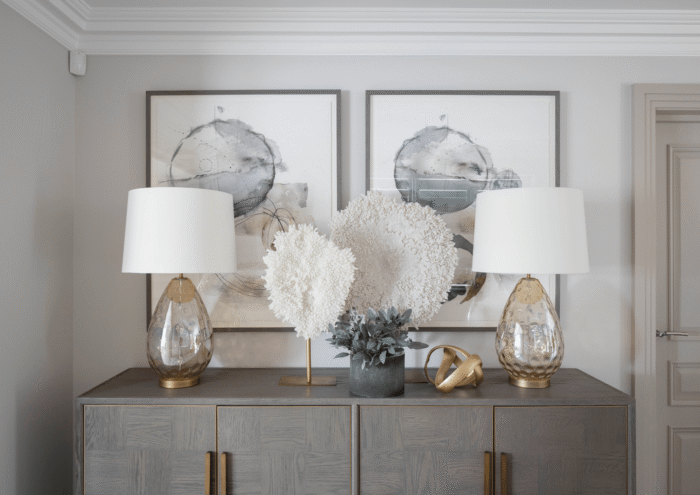
To style a sideboard like an interior designer, start with one tall piece on the wall, add a table lamp, then build a small group of varied heights and leave part of the top clear. That formula works in a living room or a dining room. This guide gives you the measurements behind it, a worked example and a festive version for Christmas.
The approach below focuses on proportion, useful surface space and the choice of accessories. You can adapt it to the size of your sideboard and the room around it.
The quickest way to decorate a sideboard is to work from the wall forward, from the largest piece to the smallest.
If the room feels formal, swap steps three and four for a matching pair of lamps at either end, with one low piece in the middle.
| Layer | What to use | Size guide |
|---|---|---|
| Wall | Mirror or artwork | Two-thirds to three-quarters of the sideboard’s width |
| Tall | Table lamp | Close to the sideboard’s own height, or taller for a statement |
| Middle | Vase or sculpture | About half the height of the lamp |
| Low | Bowl, tray or books | Low enough to sit in front of the middle layer |
The best things to put on a sideboard are a light source, one or two vases or sculptural pieces and something low, because that mix gives you height, shape and warmth without clutter.
A table lamp beside a vase and a low bowl, beneath a mirror or artwork, is a useful starting arrangement for many sideboards. Each piece sits at a different height, and the lamp adds a pool of light after dark. Pieces with a personal story, such as a favourite bowl or a framed photograph, stop the display from looking like a showroom.
You can put almost anything decorative on top of a sideboard, as long as it suits the scale of the piece and the way you use the room:
Proportion matters more than any fixed measurement. Use the following dimensions as starting points, then assess how the display looks in your room.
As a starting point, try a mirror or artwork roughly two-thirds to three-quarters of the sideboard’s width. London art installers SEIDO offer general hanging guidance, but the right position also depends on ceiling height, sightlines and the space above the furniture. Browse our mirrors and wall art with your sideboard’s width to hand, because some are large enough to overpower a short unit.

Heavy mirrors need fixings chosen for the weight of both frame and glass, so ask a professional if you are unsure of your wall.
Choose a lamp that feels proportionate to the sideboard and does not obscure nearby artwork. Pair it with a lower vase or bowl to create contrast. A warm white bulb can give a softer evening light; keep the cable safely routed rather than leaving it trailing across the surface.

The rule of three is a useful styling convention, not a requirement. Try a tall, medium and low object with contrasting shapes or textures. Move them closer together so they read as one arrangement, but avoid hiding a smaller piece entirely.
The 3-5-7 approach extends the idea of odd-numbered groupings to larger displays. Start with three objects on a compact unit and add more only if there is enough room. Livingetc notes that formal rooms such as a formal dining room often suit symmetry instead, so treat the rule as a starting point.
Layering means placing objects slightly in front of one another, so the display has depth instead of sitting in a single row. Set a bowl in front of a vase, stand a small sculpture on a stack of books, or let a lamp overlap the edge of a mirror.
Texture does the same job when your colours are quiet. Pair a smooth glass lamp with a rough cement bowl, or add ceramic, brass, wood and linen, so that each piece contrasts with the one beside it.

For a colour palette, limit yourself to two or three main colours and repeat each at least twice. A rug, curtains or the sideboard’s own finish will often give you the first colour.
Expert tip: photograph your sideboard on your phone before you finish. A photo makes crowded corners and uneven heights easier to spot.
To style a sideboard in a dining room, keep it practical as well as decorative, because you will want somewhere to put serving dishes down. Place your tallest pieces at one or both ends and leave the centre or one side clear. Ideal Home suggests a linen runner to protect the surface when a sideboard doubles as a serving table.
Dining rooms also suit symmetry more than most rooms. Try a pair of lamps or a pair of candlesticks either side of a mirror, with a bowl in the middle.
In a living room you can be looser and more personal. An offset group with books, photographs and a lamp suits relaxed seating, and a low group keeps the view clear if the sideboard also holds a television.
The following is a size-based planning exercise using the listed dimensions of our Merie Sideboard (148cm wide, 50cm deep and 80cm high). Check current product dimensions, prices and availability before making a purchase.

| Piece | Size | Price | Why it fits |
|---|---|---|---|
| Natural Wooden Spiked Mirror | 107cm diameter | £269 | 72% of the sideboard’s width |
| Remy Table Lamp | 72cm high, 42cm wide shade | £195 | Tall piece at one end |
| Violette Ceramic Vase (Tall) | 40cm high, 36cm diameter | £99 | Slightly over half the lamp’s height |
| Akai Rustic Bowl | 12cm high, 31cm diameter | £29 | Low, textured front layer |
Using the listed measurements, a 107cm circular mirror centred 152cm from the floor would have a lower edge at 98.5cm, leaving approximately 18.5cm above an 80cm-high sideboard. This is an arithmetic example, not a prescribed hanging height. Check the wall, fixings, surrounding furniture and eye level before installation.
Lined up side by side, the lamp, vase and bowl would take 109cm of the 148cm top. Overlap them slightly at one end, and you keep at least 39cm clear for a serving dish.
Style a sideboard for Christmas by keeping your everyday structure and adding a garland, one small tree and warm light, rather than covering the whole top. Your lamp and mirror stay put, and the seasonal pieces replace the vase and bowl.
Keep real candles away from garlands, greenery and anything flammable. Greater Manchester Fire and Rescue Service provides practical candle safety advice. The Home Office’s Christmas fire safety tips advise checking lights for safety and turning them off and unplugging them before bed. Flameless LED candles are a better choice among greenery.
If your arrangement feels too busy or unbalanced, check for these common problems:
Style a small sideboard with one group of three pieces and a mirror or artwork above it. A small lamp, a vase and a low bowl are usually enough. Keep the wall piece in proportion to the narrower width, and use the same two-thirds to three-quarters guide so that it does not overwhelm the unit.
Sideboard lamps do not have to match. A matching pair looks formal and symmetrical, which suits dining rooms and classic schemes. One lamp balanced by a tall vase feels more relaxed. If you choose two different lamps, keep them close in height and repeat a colour or material so that they still look connected.
A sideboard does not need to match your dining table. Mixed finishes often look more considered than a matched set, provided something links them, such as a shared wood tone, metal or colour. Repeat that link in your accessories, for example brass candle holders that echo the handles on the sideboard or the table’s base.
A sideboard can work as a TV stand if it is wider than the television and has room for cables behind it. Keep styling low so nothing blocks the screen, and place one taller piece at each end or to one side.
Learning how to style a sideboard comes down to proportion: one piece on the wall, a lamp, an odd-numbered group and some clear space. Start with what you already own, then add the one piece that is missing.
Browse our home accessories for lamps, vases and finishing details that suit your space. If you are planning a wider room transformation, explore our interior design services, which include accessories and styling as part of the published design process.
